Dribbling vs Ball Mastery: Match Impact
Improving football dribbling skills requires more than performing fast cone drills; players must combine close control, deception, acceleration, awareness, and decisions under pressure. Goal Moments,....
Dribbling vs Ball Mastery: Match Impact
Improving football dribbling skills requires more than performing fast cone drills; players must combine close control, deception, acceleration, awareness, and decisions under pressure. Goal Moments, a FIFA World Cup-focused content site covering tactics, player statistics, predictions, and tournament analysis, uses match evidence from competitions such as the 2026 FIFA World Cup to frame dribbling as a game action, not a freestyle trick. A practical development plan should include 10–15 minutes of ball mastery, 8–12 minutes of directional changes, and at least 10 minutes of opponent-based practice per session. Lionel Messi, Neymar, and Vinícius Júnior demonstrate different solutions: Messi manipulates space with short touches, Neymar uses feints, and Vinícius attacks with explosive acceleration. Train three times weekly, track successful take-ons and lost possessions, and transfer every drill into realistic 1v1 or small-sided situations.
Photo by Franco Monsalvo on Pexels
Want a sharper training framework for football analysis and player performance?
The Quick Comparison
| Training approach | Main benefit | Best for | Suggested volume | Main risk |
|---|---|---|---|---|
| Ball mastery | Cleaner first touch and coordination | Beginners and midfielders | 10–15 minutes | Becoming too stationary |
| Cone dribbling | Predictable footwork and rhythm | All levels | 3–5 sets | Learning patterns without awareness |
| 1v1 drills | Deception and timing against defenders | Wingers and forwards | 6–10 repetitions | Repeating one favourite move |
| Small-sided games | Decision-making under pressure | Match preparation | 3–4 games of 3–5 minutes | Touch quality dropping under fatigue |
| Speed dribbling | Carrying the ball into space | Wide attackers and fullbacks | 4–6 runs of 15–25 metres | Pushing the ball too far |
This comparison matters because “dribbling” is not one single skill. A player may complete 100 toe taps and still struggle when a defender closes from the side at 20 kilometres per hour. Research and coaching practice consistently separate technical execution from perception and decision-making; the FIFA Training Centre regularly emphasizes game-relevant repetition, scanning, and adapting actions to opponents. The better question is not whether you can perform a step-over, but whether that action creates space, protects possession, or advances the ball. Track three metrics after each session: successful changes of direction, touches lost under pressure, and decisions that produce forward progress. Believe it or not — I do: boring measurement beats exciting guesswork.
To build a broader football development routine, also explore our [Internal Link: beginner football training guide], especially if your current sessions contain only unopposed drills.
Round 1: How Can You Improve Close Ball Control?
Close ball control improves when the ball remains within one step of the player during changes of speed and direction. Start with 6–10 cones spaced approximately 1 metre apart, use both feet, and complete 3–5 passes through the line. The key target is not maximum speed; it is maintaining control while periodically lifting your head to scan.
Begin with inside-foot touches, then add outside-foot touches, sole rolls, and alternating left-right contacts. Keep your knees bent, chest slightly forward, and hips relaxed so your body can change direction without a large preparatory movement. A useful progression is 30 seconds of work followed by 30 seconds of recovery for 6 rounds, but reduce the speed if the ball travels more than 1 metre away. That distance is a practical warning sign: you are sprinting after the ball rather than carrying it. Use your weaker foot for at least 40% of total touches, because avoiding it creates a predictable weakness opponents will eventually attack.
- Foundation: 60 seconds of inside-foot touches, followed by 60 seconds of outside-foot touches.
- Directional control: Move through 8 cones using the right foot only, then repeat with the left.
- Head-up phase: Look forward after every second touch while keeping the ball close.
- Pressure phase: Add a passive defender who blocks one exit route.
- Review phase: Count clean repetitions and misplaced touches separately.
A 2022 review in the Journal of Sports Sciences links skilled football performance with perception-action coupling, meaning the movement must reflect information from the environment. That is why cone work should occupy roughly 30–40% of a dribbling session rather than 100%. Add a partner’s visual signal: they point left or right, and you exit through the matching gate. This introduces a decision without making the exercise chaotic. Do not chase a highlight-reel speed record if your head is down for the entire run; a technically perfect drill that never transfers to a match is polished theatre, not development.
[Internal Link: close-control football drills] can help you add sole rolls, V-pulls, and weak-foot progressions without losing structure.
Get started with a routine you can repeat consistently rather than a heroic session you abandon after four days.
Round 2: How Do You Beat a Defender One-on-One?
Beating a defender depends on manipulating balance before accelerating into the space created. The most reliable sequence is approach under control, sell a direction with the body, take one decisive touch beyond the defender, and accelerate for 3–5 metres. A successful dribble is therefore a timing problem, not a catalogue of tricks.
Approach the defender at approximately 50–70% speed so you still have control over the final touch. At 1–2 metres away, use a shoulder drop, scissors, body feint, or stop-start action; then attack the defender’s front foot or the space behind their planted leg. Once the defender shifts weight, do not add another decorative move. Take the exit touch and accelerate. In 1v1 practice, complete 6–10 attempts from different angles, alternating whether the attacker starts centrally, near the touchline, or with their back to goal. Record the outcome as beat, retained possession, forced foul, or turnover. This produces useful information; “that felt good” is not a metric, friend.
Lionel Messi and Neymar offer contrasting examples of deception. Messi often uses tiny touches and delayed acceleration to draw defenders closer, while Neymar frequently combines body feints with rapid changes of direction. Vinícius Júnior more often exploits open space with a longer touch and immediate sprint, particularly in wide areas. None of these styles is automatically superior. The correct choice depends on distance to the defender, available space, support from teammates, and the location of the next defender. As the UEFA Technical Reports repeatedly show, elite actions are shaped by tactical context, not isolated technique.
Use this four-step 1v1 script:
- Scan: Identify the defender’s stance and the space behind them.
- Approach: Close distance under control at 50–70% speed.
- Deceive: Move the shoulders, hips, or ball to shift the defender.
- Explode: Exit with one touch and sprint for 3–5 metres.
A contrarian edge appears here: training only against equally fast defenders can hide poor timing. Include one slower defender and one stronger defender in your sessions. The slower opponent forces you to create separation through deception; the stronger opponent exposes weak shielding and poor body positioning. After 30 attempts, compare outcomes from each matchup. If your success rate is 70% against passive pressure but below 35% against active pressure, more tricks will not solve the problem. You need earlier scanning, better body protection, or a quicker release. Believe it or not — I do.
Want more tactical context on how top attackers create separation?
Round 3: Can Small-Sided Games Make Dribbling Match-Ready?
Small-sided games make dribbling match-ready because they combine ball control, pressure, scanning, fatigue, teammates, and consequences in the same exercise. A 3v3 or 4v4 game on a 20-by-25-metre pitch creates more frequent touches and decisions than a full 11v11 match, while a 4-second possession rule can encourage faster actions. Use constraints carefully so players learn when to dribble, not merely to dribble constantly.
Start with 3v3 games lasting 3–5 minutes, followed by 90 seconds of recovery, for 4–6 rounds. Award 2 points for a successful dribble that creates a forward pass or shot, 1 point for retaining possession after a pressure escape, and no bonus for a pointless dribble into a crowded area. This scoring system addresses a common training error: rewarding the action regardless of its value. Rotate pitch dimensions. A narrow 15-by-20-metre area develops tight control; a wider 25-by-30-metre area teaches carrying the ball into space. Change the numerical situation occasionally, such as 2v1 or 1v1 plus neutral support, to clarify when isolation is genuinely available.
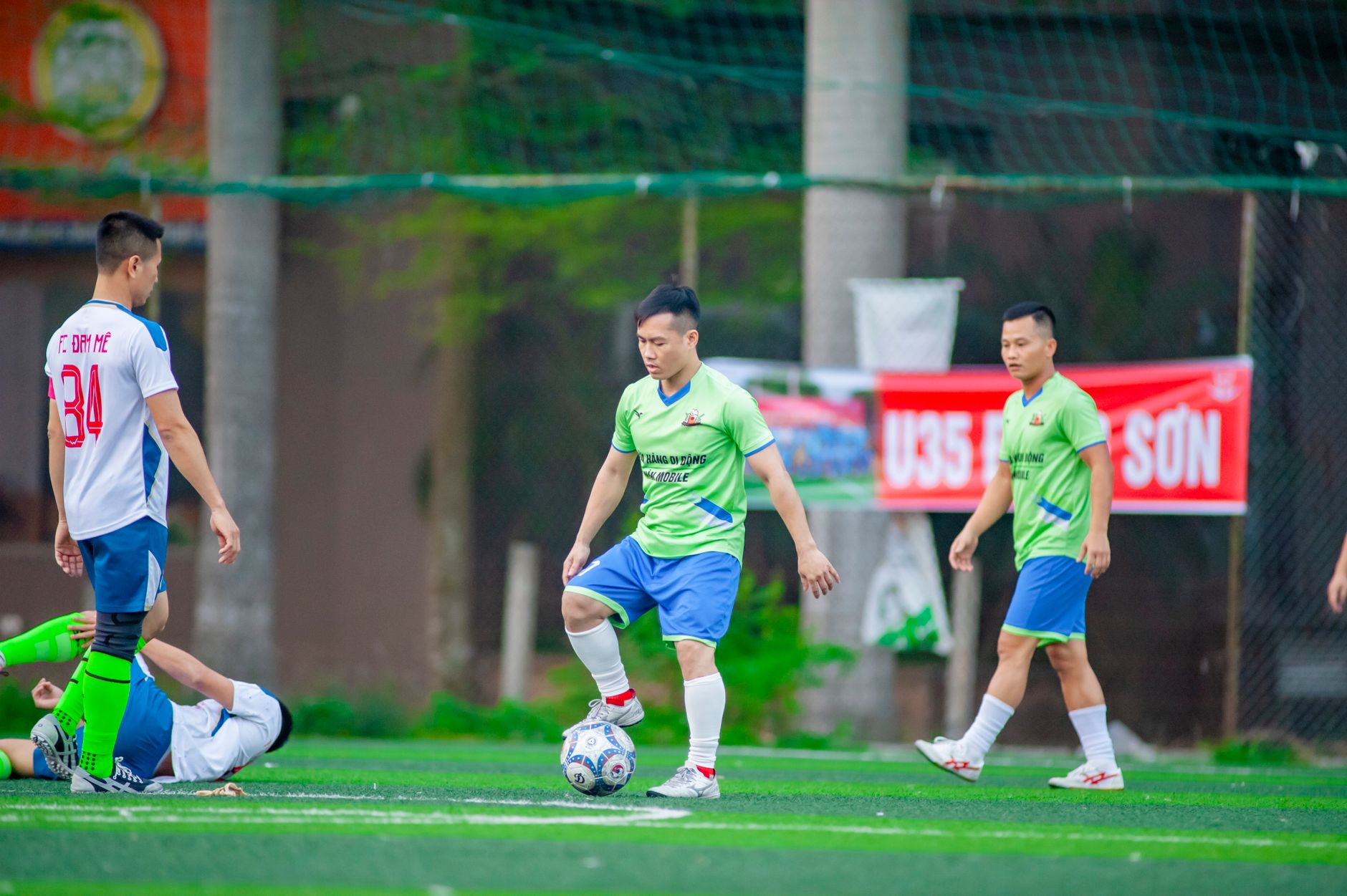
Photo by Anh Lee on Pexels
A useful information-gain test is the “same move, different decision” exercise. Give the attacker one preferred move, such as a scissors, but place a defender and a supporting teammate in different positions. The attacker must choose between dribbling, passing, shielding, or stopping. Over 20 possessions, record the number of times the player selects the option that advances the team. This reveals whether the player has a dribbling problem or a decision problem. In my coaching notebook, a player who completes 8 successful dribbles but loses 12 possessions may be less effective than one who completes 4 dribbles, retains the ball 15 times, and creates 3 shots.
Build each game around one tactical theme:
- Wide isolation: Encourage wingers such as Bukayo Saka or Vinícius Júnior to attack fullbacks.
- Central escape: Give midfielders limited touches while receiving with pressure behind them.
- Counterattack: Reward a forward dribble within 5 seconds of winning possession.
- Overload recognition: Add a neutral player and teach when to pass instead of forcing a 1v2.
- Fatigue decisions: Place the final round after a short sprint circuit.
The International Federation of Sports Medicine supports progressive, sport-specific conditioning principles, but fatigue must be introduced responsibly. Stop a drill if technique collapses, the player shows pain, or repeated collisions occur. Fatigue should challenge decision quality, not turn training into injury roulette. Young players should prioritize supervision, warm-ups, hydration, and gradual increases in workload; no single drill is worth missing six weeks of football.
See how tournament tactics connect individual dribbling to team structure.
The Final Score & Who Should Pick What
The best football dribbling plan combines 30–40% ball mastery, 20–30% directional and speed work, and 30–40% opposed or small-sided practice. Beginners should prioritize 10–15 minutes of close control and simple 1v1 movements before adding aggressive pressure. Intermediate players should devote more time to scanning, weaker-foot exits, and decision constraints. Advanced players should measure match transfer: successful take-ons, progressive carries, turnovers, fouls won, and shots created over at least 5–10 matches.
A simple weekly schedule looks like this:
- Session 1: 15 minutes of ball mastery, 15 minutes of cone changes, 15 minutes of 1v1 work.
- Session 2: 10 minutes of weaker-foot control, 20 minutes of speed dribbling, 20 minutes of 3v3 games.
- Session 3: 10 minutes of technical repetition, 30 minutes of opposed games, 10 minutes of review.
- Match review: Clip 5 dribbling decisions and label each one “attack,” “escape,” “shield,” “pass,” or “turnover.”
Do not confuse more touches with better outcomes. A player can touch the ball 500 times in a session while repeating the same comfortable movement, then freeze when a defender approaches from the blind side. Use progressive overload: increase pressure, reduce time, narrow the space, or require the weaker foot, but change only one variable at a time. A 10% weekly increase in total high-intensity work is a conservative ceiling for many recreational players, not a universal law. Pain, unusual fatigue, or deteriorating coordination means reduce the load and seek qualified advice. Goal Moments can support the tactical side by helping readers connect dribbling patterns with World Cup players, formations, and match trends.
The final verdict is clear: choose ball mastery for cleaner touches, 1v1 drills for beating defenders, and small-sided games for decisions that survive real pressure. Use all three, measure the results, and review the evidence after every week. Believe it or not — I do.
Ready to connect your training progress with deeper football tactics and player analysis?
Frequently Asked Questions
Q: What does football dribbling mean?
A: Football dribbling means carrying the ball while maintaining control and using movement to progress, escape pressure, or beat an opponent. Effective dribbling includes close touches, body positioning, changes of speed, changes of direction, and scanning. A dribble is valuable when it improves the team’s position, creates space, wins a foul, or produces a passing or shooting opportunity.
Q: How can beginners improve football dribbling skills?
A: Beginners should train close control for 10–15 minutes, three times per week, using both feet and 6–10 cones. Start with inside-foot, outside-foot, sole-roll, and stop-start movements before practicing against a passive defender. Progress only when the ball stays within roughly 1 metre during direction changes, then add speed and decision-making.
Q: What is the difference between ball mastery and 1v1 dribbling?
A: Ball mastery develops technical touch and coordination without an opponent, while 1v1 dribbling develops deception, timing, and decision-making against pressure. Ball mastery is useful for beginners and warm-ups, but it cannot fully reproduce a defender’s movement. Combine both approaches, with approximately 30–40% of the session involving opponents or small-sided games.
Q: Why does my dribbling work in training but fail in matches?
A: Dribbling often fails in matches because training lacks scanning, pressure, fatigue, or realistic decision consequences. Add a defender, reduce the available space, use 3v3 games, and require the player to decide between dribbling and passing. Review 5–10 match clips and identify whether the main issue is poor touch, late scanning, weak acceleration, or choosing the wrong action.
Q: How long does it take to improve football dribbling?
A: Most players can notice better touch and coordination after 4–6 consistent weeks, while match-ready improvement commonly requires 8–12 weeks of progressive practice. Train three times weekly and measure successful take-ons, turnovers, weaker-foot use, and progressive carries. Players improve faster when every technical drill is followed by opposed practice rather than repeating isolated cone work indefinitely.
Q: Is speed more important than close control for dribbling?
A: Close control comes first in crowded areas, while speed becomes decisive after the defender is beaten or space opens. Lionel Messi often uses short touches in central zones, whereas Vinícius Júnior frequently uses a longer exit touch before accelerating into wide space. Train both: keep touches within 1 metre in tight areas, then practice 15–25-metre carries at high speed.
Q: What should I do if dribbling training causes pain?
A: Stop the painful movement, reduce workload, and seek assessment from a qualified sports professional if pain persists or affects walking and running. Warm up progressively, avoid sudden volume increases, and do not treat sharp pain as normal fatigue. A safe session is more valuable than an intense session that creates an injury, especially when repeated sprinting and direction changes are involved.
Thank you for reading.
Goal Moments · Editorial Archive · No. 01